









Introduction
Over the past several decades, the global outdoor community has been characterized by rapid technological advancement. Lightweight synthetic materials, GPS navigation, satellite communication devices, high-calorie packaged foods, and specialized gear have reshaped how humans interact with wilderness environments. Yet, paradoxically, a powerful counter-movement is now gaining momentum. Across continents and cultures, outdoor enthusiasts, survival practitioners, explorers, and educators are increasingly returning to the most basic primitive techniques—skills rooted in stone, fire, fiber, wood, and deep ecological understanding.
This shift does not represent a rejection of modern technology, but rather a recalibration of values. In a world saturated with convenience, automation, and digital dependency, many are rediscovering the relevance of ancestral knowledge. Primitive skills offer more than functional survival methods; they provide psychological grounding, cultural continuity, environmental literacy, and a renewed sense of human capability. This article presents a comprehensive, professional, and structured analysis of why the global outdoor community is returning to foundational primitive techniques, how these skills are practiced today, and what this trend reveals about humanity’s evolving relationship with nature.
1. Understanding Primitive Techniques in the Modern Context
1.1 What Are “Primitive Techniques”?
Primitive techniques refer to survival and living skills developed before industrialization and modern technology. They are characterized by:
- Minimal reliance on manufactured tools
- Use of natural, locally available materials
- Skill-based rather than gear-based solutions
- Deep understanding of ecological systems
Examples include friction fire making, stone tool knapping, natural shelter construction, cordage production from plant fibers, and traditional tracking and navigation methods.
1.2 Primitive Does Not Mean Inferior
A common misconception equates “primitive” with “inefficient” or “outdated.” In reality, many primitive techniques are:
- Highly refined through thousands of years of experimentation
- Optimized for sustainability and resilience
- Adaptable across diverse environments
Their endurance across millennia demonstrates functional excellence rather than technological deficiency.
2. Historical Foundations of Primitive Outdoor Skills
2.1 Indigenous Knowledge Systems
Primitive techniques are deeply rooted in indigenous cultures worldwide. These knowledge systems integrate:
- Seasonal ecological patterns
- Animal behavior and tracking
- Plant uses for food, medicine, and materials
- Sustainable harvesting practices
For indigenous communities, these skills were not hobbies but essential components of daily life and cultural identity.
2.2 The Disruption of Industrialization
The Industrial Revolution dramatically altered human interaction with nature. Mechanization and mass production led to:
- Loss of traditional skills
- Increased separation from ecological processes
- Dependence on external supply chains
As societies modernized, many primitive techniques were marginalized or forgotten.
2.3 Survival Knowledge in Extreme Historical Contexts
Despite industrialization, primitive skills resurfaced repeatedly during periods of crisis—wars, exploration, and frontier expansion—highlighting their enduring relevance when modern systems failed.

3. Why the Global Outdoor Community Is Returning to Primitive Skills
3.1 Technological Saturation and Skill Atrophy
Modern outdoor activities often rely heavily on equipment. While effective, this dependence can lead to:
- Reduced situational awareness
- Overconfidence in technology
- Skill degradation
Primitive techniques restore confidence rooted in personal capability rather than devices.
3.2 Psychological Resilience and Mental Health
Practicing primitive skills has measurable psychological benefits:
- Reduced cognitive overload
- Increased mindfulness and focus
- Enhanced stress tolerance
The slow, deliberate nature of primitive tasks counters the pace of digital life.
3.3 Authenticity and Meaning in Outdoor Experience
Many outdoor enthusiasts seek experiences that feel earned rather than consumed. Primitive techniques:
- Require patience and repetition
- Produce tangible outcomes
- Foster a sense of mastery
This authenticity is a powerful motivator behind the trend.
4. Core Primitive Skills Experiencing a Revival
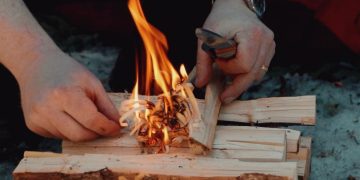
4.1 Fire Making Without Modern Tools
Friction fire methods—such as bow drill and hand drill—are among the most emblematic primitive skills.
Key aspects include:
- Understanding wood properties
- Managing moisture and friction
- Coordinating precise physical technique
Fire made this way represents self-sufficiency at its most elemental.
4.2 Stone Tool Knapping
Knapping transforms stone into cutting tools through controlled fracturing. The revival of knapping highlights:
- Precision and material science knowledge
- Hand-eye coordination
- Appreciation for early human ingenuity
Stone tools remain functional, durable, and environmentally neutral.
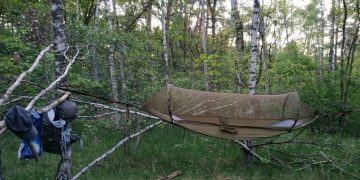
4.3 Natural Shelter Construction
Primitive shelters use materials such as branches, leaves, bark, and earth. Skills include:
- Site selection
- Insulation principles
- Structural stability
Shelter-building deepens understanding of thermoregulation and environmental exposure.
4.4 Cordage and Fiber Technology
Cordage production from plant fibers, sinew, or bark demonstrates:
- Botanical knowledge
- Mechanical understanding of tension and twist
- Multi-purpose problem-solving
Cordage is foundational to tool-making, shelter, and hunting systems.
4.5 Tracking and Primitive Navigation
Tracking sharpens observational skill and ecological literacy. Practitioners learn to read:
- Ground disturbance
- Broken vegetation
- Animal movement patterns
Navigation without instruments relies on celestial cues, terrain, and environmental indicators.
5. Bushcraft, Primitive Survival, and Modern Interpretation
5.1 Bushcraft as a Bridge Discipline
Bushcraft blends primitive techniques with selective modern tools. It emphasizes:
- Skill depth over speed
- Long-term wilderness living
- Ethical resource use
Bushcraft serves as a transitional discipline for those moving toward more primitive practice.
5.2 Experimental Archaeology and Skill Validation
Experimental archaeology plays a vital role by:
- Reconstructing ancient tools and methods
- Testing historical hypotheses
- Validating feasibility through replication
This scientific approach reinforces the legitimacy of primitive skills.
6. Environmental and Sustainability Dimensions
6.1 Low-Impact Living Principles
Primitive techniques inherently promote sustainability:
- Biodegradable materials
- Minimal waste
- Renewable resource cycles
These practices align closely with modern environmental ethics.
6.2 Relearning Ecological Limits
Primitive living forces practitioners to confront:
- Resource scarcity
- Seasonal variability
- Carrying capacity of ecosystems
This awareness fosters respect rather than exploitation.
6.3 Conservation Through Knowledge
Understanding how ecosystems function from a survival perspective enhances conservation advocacy. People protect what they truly understand.
7. Physical and Cognitive Demands of Primitive Skills
7.1 Embodied Knowledge
Primitive skills rely on embodied intelligence—knowledge stored in muscle memory, perception, and intuition rather than manuals or screens.
7.2 Developing Patience and Precision
Unlike modern tools, primitive methods:
- Punish impatience
- Reward consistency
- Require fine motor control
This retrains attention and discipline.
7.3 Risk Awareness and Decision-Making
Primitive techniques sharpen risk assessment because margins for error are narrower. Practitioners become more deliberate and cautious.
8. Ethics, Cultural Respect, and Responsibility
8.1 Respecting Indigenous Origins
Many primitive skills originate from living cultures. Ethical practice requires:
- Acknowledgment of sources
- Avoiding cultural appropriation
- Supporting indigenous voices and educators
8.2 Legal and Environmental Boundaries
Primitive practice must respect:
- Protected lands
- Wildlife regulations
- Fire restrictions
Responsibility is integral to legitimacy.
8.3 Teaching Versus Performing
There is a critical difference between sharing knowledge and performing survival for spectacle. Responsible practitioners emphasize education over bravado.
9. The Role of Community and Knowledge Transmission
9.1 Learning Through Mentorship
Primitive skills are best transmitted through:
- Direct demonstration
- Long-term mentorship
- Repetitive practice
This mirrors ancient teaching methods.
9.2 Modern Gatherings and Skill Circles
Primitive skill gatherings provide:
- Peer learning environments
- Cross-cultural exchange
- Preservation of endangered knowledge
These communities act as living archives.
9.3 Digital Media as a Double-Edged Tool
Online platforms can:
- Expand access to information
- Inspire participation
But they can also oversimplify complex skills. Depth requires offline practice.
10. Why This Return Matters in the 21st Century
10.1 Resilience in an Uncertain World
Primitive skills offer adaptive resilience in the face of:
- Climate instability
- Supply chain disruption
- Technological failure
They are not anti-modern, but post-modern safeguards.
10.2 Reclaiming Human Capability
At its core, this movement restores confidence in human potential:
- Hands can still make fire
- Minds can still read landscapes
- Communities can still pass down wisdom
10.3 Redefining Progress
The return to primitive techniques challenges linear notions of progress. It suggests that advancement does not always mean addition—sometimes it means recovery.
Conclusion
The gradual return of the global outdoor community to fundamental primitive techniques reflects a profound cultural and psychological shift. In rediscovering fire made by friction, shelters built from forest debris, tools shaped from stone, and navigation guided by land and sky, modern humans are not moving backward—they are reconnecting with a deeper layer of competence that has always existed.
These skills foster resilience, humility, and ecological understanding in ways modern technology alone cannot. They remind us that beneath innovation and infrastructure lies an ancient, capable human being—one who can adapt, create, and survive with little more than knowledge, patience, and respect for the natural world.
As the outdoor community continues to evolve, the revival of primitive skills stands not as a rejection of modernity, but as its necessary balance. By remembering what our ancestors knew, we strengthen our capacity to face an uncertain future—grounded in the timeless intelligence of human hands, minds, and landscapes.