







The oceans of Earth conceal countless mysteries, with vast stretches remaining unexplored, and within these depths lie submerged ruins and “lost” regions that spark imagination and scientific inquiry alike. From ancient civilizations swallowed by rising seas to natural phenomena that render entire regions virtually invisible on maps, the ocean remains a repository of history, mystery, and unexplored frontiers. Archaeologists, oceanographers, and historians increasingly turn to advanced technologies to map and study these underwater landscapes, revealing insights into human history, geology, and climate change.
This article provides a comprehensive exploration of lost sea regions and submerged ruins, examining historical records, geological mechanisms, archaeological discoveries, and the technological advancements that allow researchers to study these enigmatic underwater environments. Through this lens, the ocean emerges not only as a habitat for extraordinary life forms but also as a historical archive waiting to be deciphered.
1. Introduction: The Allure of Lost Sea Regions
1.1 Defining Lost Sea Regions
- Lost sea regions refer to areas that have disappeared from historical maps, either due to rising sea levels, tectonic activity, or inaccuracies in early cartography.
- Examples include submerged lands like Doggerland in the North Sea and the legendary Atlantis.
- Such regions often coincide with remnants of human habitation, suggesting complex interactions between humans and environmental change.
1.2 Importance of Study
- Reconstructing submerged landscapes provides insight into prehistoric human migrations, settlement patterns, and environmental adaptation.
- Understanding geological mechanisms that submerged these regions informs studies of climate change, tectonic shifts, and coastal evolution.
1.3 Challenges in Exploration
- Depth and inaccessibility limit direct observation.
- Sediment accumulation and strong currents obscure ruins.
- Remote sensing, sonar, and underwater robotics are essential for systematic exploration.
2. Geological Mechanisms Behind Submerged Landscapes
2.1 Rising Sea Levels
- Post-glacial sea-level rise submerged vast coastal plains.
- Doggerland: Once connecting Britain to mainland Europe, submerged approximately 7,500–8,000 years ago.
- Implications: Coastal civilizations lost their land, artifacts, and settlements to the rising ocean.
2.2 Tectonic Activity and Subduction
- Earthquakes, volcanic eruptions, and plate movements reshape seafloor topography.
- Examples: Santorini eruption (~1600 BCE) and its role in submerging parts of the Minoan civilization.
- Seismic activity may create sudden submergence events, producing “lost” regions.
2.3 Sedimentation and Ocean Currents
- Strong currents and sediment deposition can bury ancient settlements.
- Over millennia, cities and natural features become completely concealed under layers of silt and sand.
2.4 Catastrophic Events
- Tsunamis and sudden flooding have historically destroyed coastal communities.
- Geological records confirm rapid submergence events in multiple regions, leaving archaeological evidence underwater.
3. Submerged Archaeological Discoveries
3.1 Sunken Cities
- Dwarka, India: Submerged city off the Gujarat coast, associated with ancient Indian texts. Excavations revealed stone structures and artifacts.
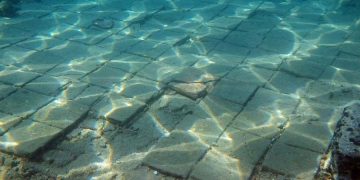
- Pavlopetri, Greece: 5,000-year-old submerged city with streets, buildings, and tombs.
- Thonis-Heracleion, Egypt: Ancient port city submerged near the Nile Delta; recovered artifacts include statues, temples, and coins.
3.2 Shipwrecks and Maritime Archaeology
- Sunken ships provide insight into trade routes, naval warfare, and cultural exchange.
- Examples: Uluburun shipwreck (Turkey, Bronze Age), Spanish galleons in the Caribbean, and World War II wrecks in the Pacific.
3.3 Cultural and Religious Sites
- Submerged temples, altars, and ritual sites indicate human interaction with water bodies.
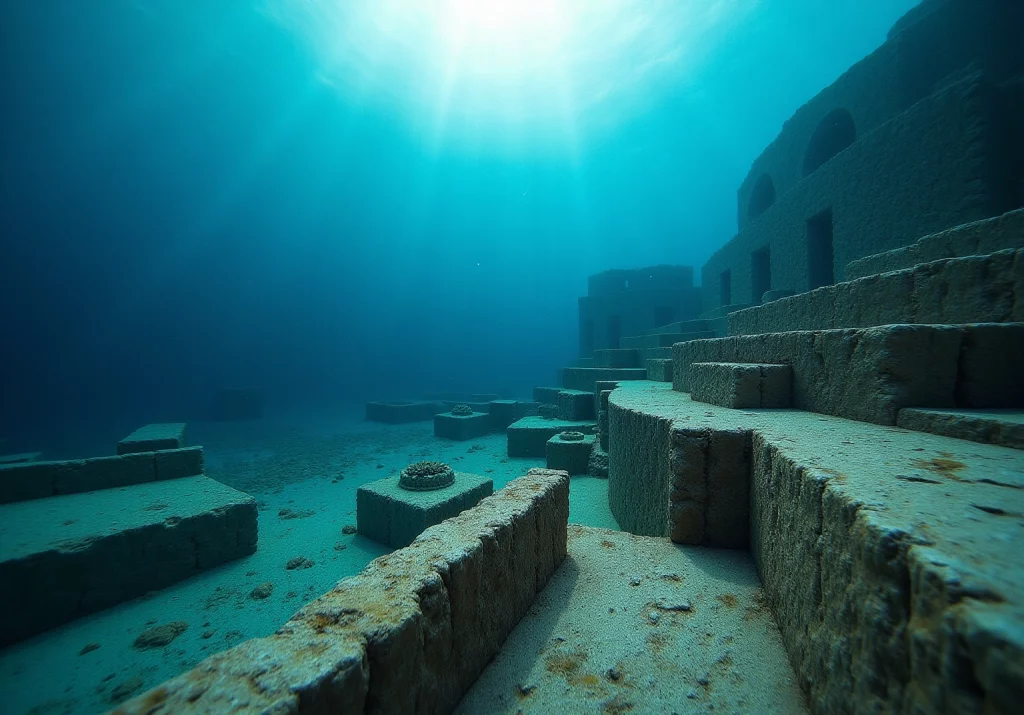
- Example: Yonaguni Monument, Japan—pyramidal structures suggest a prehistoric civilization or natural formation debated among researchers.
3.4 Fossilized Evidence
- Ancient riverbeds and coastal plains now underwater contain fossilized remains of humans and megafauna.
- Provides evidence for migration patterns and climate adaptation.
4. Legendary Lost Continents and Myths
4.1 Atlantis
- Described by Plato as a technologically advanced civilization lost to the sea.
- Debate continues regarding its literal or allegorical nature.
- Modern explorations propose possible locations in the Mediterranean, Atlantic Ocean, and Caribbean.
4.2 Lemuria and Mu
- Hypothetical landmasses proposed to explain biogeographical patterns in species distribution.
- Though scientifically unverified, these concepts reflect human fascination with vanished continents.
4.3 Flood Myths Across Cultures
- Global myths of cataclysmic floods—Noah’s Ark, the Epic of Gilgamesh, Deucalion—may reflect historical submergence events.
- Correlating myths with geological evidence offers insights into ancient environmental events.
5. Modern Techniques for Exploring Submerged Regions
5.1 Sonar Mapping
- Multibeam and side-scan sonar generate detailed seafloor maps.
- Detect structures, trenches, and unusual topography.
5.2 Remote Operated Vehicles (ROVs)
- Equipped with cameras and robotic arms for visual inspection and artifact recovery.
- Operate in extreme depths and hazardous conditions.
5.3 Satellite and Aerial Remote Sensing
- LIDAR and radar detect submerged coastal features in shallow waters.
- Used for mapping ancient riverbeds and shorelines.
5.4 Environmental DNA (eDNA)
- Detects human, animal, and plant DNA in sediments, providing evidence for past habitation.
- Non-invasive method reduces ecological disturbance.
5.5 Advanced 3D Modeling
- Combines sonar, photographic, and LIDAR data for virtual reconstruction of submerged sites.
- Assists in understanding urban planning, architectural techniques, and settlement patterns.
6. Ecological and Geological Significance
6.1 Habitats Created by Submerged Structures
- Sunken cities and shipwrecks serve as artificial reefs.
- Support diverse marine life including corals, fish, and invertebrates.
6.2 Insights into Paleoenvironments
- Sediment layers and submerged landforms reveal past sea levels, climate patterns, and ecosystem dynamics.
6.3 Conservation Implications
- Underwater archaeological sites are vulnerable to looting, pollution, and deep-sea mining.
- International regulations protect these heritage sites while promoting scientific research.
7. Case Studies of Notable Lost Sea Regions
7.1 Doggerland (North Sea)
- Submerged after the last Ice Age.
- Archaeological evidence: Flint tools, mammoth bones, and human artifacts recovered through dredging.
7.2 Sundaland (Southeast Asia)
- Large landmass connecting present-day islands, submerged due to post-glacial sea-level rise.
- Early human populations adapted to shifting coastlines, leaving archaeological traces underwater.
7.3 Caribbean Sunken Landscapes
- Coastal inundation during Holocene rise created submerged lagoons and coral reefs.
- Early Mayan and Taino artifacts occasionally recovered from shallow waters.
7.4 Mediterranean Submergence
- Sites like Pavlopetri and Heracleion illustrate complex interactions of sedimentation, tectonics, and human settlement.
8. The Role of Technology in Future Exploration
8.1 Autonomous Underwater Vehicles (AUVs)
- Map large swaths of the ocean floor autonomously.
- Equipped with high-resolution sonar, cameras, and chemical sensors.
8.2 Artificial Intelligence (AI)
- AI algorithms analyze sonar and imaging data to identify potential ruins.
- Accelerates discovery while reducing human error.
8.3 Interdisciplinary Approaches
- Collaboration between archaeologists, oceanographers, geologists, and historians enhances site interpretation.
- Combines artifact study, sediment analysis, and ecological assessment.
9. The Human Fascination with Lost Regions
9.1 Cultural Inspiration
- Sunken cities and lost continents inspire literature, film, and art.
- Reflect collective curiosity about origins, mystery, and human impermanence.
9.2 Educational and Scientific Value
- Underwater archaeology provides tangible links to human history.
- Engages public interest in science, conservation, and heritage preservation.
9.3 Ethical Considerations
- Balancing exploration with preservation is critical.
- Looting, commercialization, and environmental degradation pose ongoing risks.
10. Conclusion
Lost sea regions and submerged ruins represent a convergence of natural forces and human history. Rising seas, tectonic shifts, and catastrophic events have concealed entire landscapes, leaving behind fragments of ancient civilizations, geological phenomena, and ecological legacies. Studying these regions reveals not only the ingenuity and adaptability of human societies but also the complex processes shaping the Earth’s surface over millennia.
Modern exploration technologies—ROVs, AUVs, sonar mapping, and eDNA analysis—allow unprecedented access to these submerged worlds. Each discovery expands our understanding of ancient cultures, coastal dynamics, and marine ecosystems while emphasizing the importance of conservation and responsible research.
The ocean’s depths, hiding lost cities and forgotten landscapes, remind us that history is fluid and often concealed beneath layers of sediment and water. These submerged realms continue to inspire wonder, offering profound insights into the past while challenging us to explore responsibly and think critically about humanity’s place in a dynamic planet. The mystery of lost sea regions stands as a testament to the enduring allure of the unknown, bridging science, history, and imagination.