









A Comprehensive Examination of the Global Return to Analog Navigation Skills in an Era of Digital Vulnerability
Abstract
Over the past two decades, rapid advancements in digital and satellite-based navigation have reshaped global transportation, defense strategy, commercial logistics, and everyday mobility. Yet despite the unparalleled accuracy and convenience of GPS, GLONASS, Galileo, and BeiDou systems, several nations are observing a surprising shift: a renewed emphasis on traditional navigation—skills once considered obsolete. From celestial navigation and dead-reckoning to map-and-compass land navigation, countries across Europe, Asia, and the Americas are rediscovering the strategic value of analog techniques. This 3,200-plus-word article examines the drivers behind this revival, the methodologies incorporated into modern training, the interplay between analog and digital systems, and the future implications for global security, resilience, and education.
Table of Contents
- Introduction
- The Modern Dependence on Digital Navigation Systems
- Why Traditional Navigation is Making a Comeback
- 3.1 Vulnerability of Satellite Systems
- 3.2 Cybersecurity and Spoofing Threats
- 3.3 Military Preparedness and Redundancy
- 3.4 Cultural and Educational Value
- Types of Traditional Navigation Being Reintroduced
- 4.1 Celestial Navigation
- 4.2 Dead-Reckoning
- 4.3 Map-and-Compass Navigation
- 4.4 Maritime Piloting and Terrestrial Wayfinding
- Case Studies: Nations Leading the Revival
- 5.1 United States
- 5.2 United Kingdom
- 5.3 Japan
- 5.4 Nordic Countries
- 5.5 Singapore and Maritime Nations
- Training Methodologies in the 21st Century
- Technological Synergy: Integrating Analog and Digital Navigation
- Challenges and Criticisms of the Revival
- Long-Term Implications for Defense, Education, and Society
- Conclusion
1. Introduction
For most of the 21st century, navigation has been synonymous with digital convenience. Smartphones, smartwatches, autonomous vehicles, unmanned maritime vessels, and aircraft rely heavily on satellite navigation systems that rarely fail and deliver pinpoint accuracy. In this environment, the ancient art of navigating by the stars, charts, bearings, or visual markers seemed destined to fade into history.
Yet, in a surprising reversal, several nations are actively reintroducing traditional navigation methods into their military, maritime, and educational training programs. What began as a niche preservation movement is now regarded as a strategic imperative—one rooted in the understanding that technological dependence brings both capability and fragility.
This article explores the complex motivations and global trends behind this shift, demonstrating how traditional navigation, far from being outdated, has become essential to future resilience.
2. The Modern Dependence on Digital Navigation Systems
The omnipresence of satellite-based navigation has created a world organized around precise coordinates and real-time tracking.
2.1 Global Positioning Systems in Everyday Life
- Commercial aviation routes rely on near-continuous satellite communication.
- Maritime shipping lanes depend on GPS-supported autopilot systems.
- Emergency services use digital mapping to optimize response times.
- Agriculture and construction rely on centimeter-level GPS accuracy.
- Civilian life—from ordering a taxi to hiking—leans on mobile navigation apps.
The efficiency and reliability of digital tools have encouraged a near-complete shift away from analog skills. Applications that once required physical maps, compass bearings, or manual calculations are now automated through algorithms.
Yet with convenience comes vulnerability.
3. Why Traditional Navigation is Making a Comeback
The global return to analog navigation is not sentimental nostalgia. It is a strategic, tested, and increasingly necessary response to real-world threats.
3.1 Vulnerability of Satellite Systems
Satellite constellations—despite their sophistication—are susceptible to:
- Signal jamming from hostile military forces or criminal organizations.
- Geomagnetic storms capable of disrupting satellite communications.
- Orbital congestion and space debris collisions.
- Intentional destruction, such as anti-satellite (ASAT) weapon tests.
For nations heavily dependent on satellite guidance, even temporary disruption could cripple transportation networks, defense operations, and communication systems.
3.2 Cybersecurity and Spoofing Threats
A growing concern among cybersecurity experts is GPS spoofing—the manipulation of satellite signals to produce false coordinates.
Real-world incidents include:
- Ships in the Black Sea suddenly appearing thousands of kilometers inland.
- Aircraft receiving subtly altered altitudes or headings.
- Autonomous vehicles veering off intended paths.
As digital navigation becomes more interlinked with critical infrastructure, the stakes of interference grow exponentially.
3.3 Military Preparedness and Redundancy
Modern militaries understand that relying solely on digital infrastructure is inherently risky. The reintroduction of traditional navigation ensures:
- Operational continuity during satellite outages.
- Increased resilience in hostile electronic warfare environments.
- Improved strategic autonomy without reliance on foreign satellite networks.
- Enhanced cognitive understanding of geography, terrain, and orientation.
Training soldiers, sailors, and pilots to navigate without electronics ensures that defensive and offensive capabilities remain intact under all circumstances.
3.4 Cultural and Educational Value
Beyond practical necessity, many nations recognize the cultural and intellectual value of traditional navigation.
These skills promote:
- Spatial reasoning
- Environmental awareness
- Mathematical understanding
- Historical appreciation
In some regions, traditional navigation remains a living cultural heritage—particularly in Polynesian, Indigenous Arctic, and Scandinavian communities.
4. Types of Traditional Navigation Being Reintroduced
Modern training programs vary by nation, but several core methods are consistently revived.
4.1 Celestial Navigation
Celestial navigation—once the backbone of global exploration—involves using the position of stars, the sun, moon, or planets to determine location.
Training includes:
- Sextant measurements
- Using celestial almanacs
- Calculating latitude and longitude
- Determining time using celestial events
Reintroduced because of its complete independence from electronics, celestial navigation remains vital for maritime and long-range aerial operations.
4.2 Dead-Reckoning
Dead-reckoning calculates position using:
- Direction
- Speed
- Time traveled
- Last confirmed location
It is simple yet reliable in environments where visibility or satellite signals are compromised.
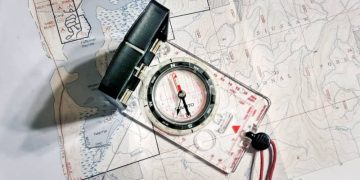
4.3 Map-and-Compass Navigation
Essential for infantry, special forces, and search-and-rescue units, this method teaches:
- Reading topographic maps
- Plotting bearings
- Compensating for magnetic declination
- Terrain association
- Precision land navigation under stress
4.4 Maritime Piloting and Terrestrial Wayfinding
Countries with long coastlines or mountainous terrain emphasize analog methods such as:
- Landmark recognition
- Coastal contour navigation
- Soundings and depth analysis
- Aural and visual cues in forests or deserts
These skills are crucial in low-visibility or electronic warfare scenarios.
5. Case Studies: Nations Leading the Revival
Several nations have taken significant steps to revive analog navigation.
5.1 United States
The U.S. Naval Academy famously restored celestial navigation training in response to cybersecurity concerns. Naval cadets now learn sextant use, manual calculations, and celestial theory—skills once removed from the curriculum in the late 1990s.
The U.S. Army has similarly reinvigorated land navigation programs, emphasizing compass-based orientation under field conditions.
5.2 United Kingdom
The Royal Navy and Royal Air Force utilize a hybrid approach integrating modern navigation with traditional charting. Britain’s experience with the North Atlantic—an area prone to magnetic anomalies—makes analog skills particularly important.
5.3 Japan
Japan’s Maritime Self-Defense Force trains extensively in celestial navigation as part of its Pacific-wide operational readiness. Earthquake and tsunami risks also highlight the need for systems independent of fragile digital infrastructure.
5.4 Nordic Countries
Norway, Sweden, Finland, and Iceland focus heavily on traditional land and sea navigation due to:
- Arctic electromagnetic disturbances
- High geomagnetic latitude
- Sparse infrastructure
- Demanding terrain
Specialized winter navigation courses emphasize landscape reading, wind patterns, snow morphology, and dead-reckoning in polar darkness.
5.5 Singapore and Maritime Nations
Major maritime hubs such as Singapore, the Philippines, and Greece maintain robust analog navigation instruction to mitigate risks associated with crowded shipping lanes and electronic interference.
6. Training Methodologies in the 21st Century
Nations adopting traditional navigation in modern curricula employ several innovative methods:
6.1 Mixed-Reality and Simulation
High-fidelity simulators allow trainees to practice celestial navigation, map-reading, or maritime piloting under variable weather and visibility conditions.
6.2 Field-Based Navigation Challenges
Exercises involve:
- Nighttime land navigation
- Long-range marches across complex terrain
- Ocean voyages without GPS
- Aircraft training with radio and celestial fixes only
6.3 Integration with STEM Education
Students learn:
- Applied mathematics (triangulation, declination, geometry)
- Astronomy fundamentals
- Earth science and magnetic field behavior
6.4 Stress and Decision-Making Training
Analog navigation builds confidence and independence, reducing “digital over-trust” and improving situational awareness.
7. Technological Synergy: Integrating Analog and Digital Navigation
The goal is not to replace digital navigation, but to complement it.
7.1 Fault-Tolerant Architecture
Systems combine:
- GPS + inertial navigation
- Celestial backups
- Manual plotting stations
- Magnetic compass fail-safes
7.2 Enhanced Software Tools
Modern digital systems include:
- Celestial navigation calculation apps
- Paper chart digitizers
- Multi-layer map interfaces
7.3 Human-Machine Teaming
Operators who understand underlying principles can identify and correct digital errors quickly—reducing the risk of catastrophic reliance.
8. Challenges and Criticisms of the Revival
Despite its benefits, the resurgence faces several hurdles:
8.1 Training Costs
Analog navigation requires:
- Specialized instructors
- Field exercises
- Equipment like sextants, compasses, and charts
8.2 Time Constraints
Students already carry heavy curricula. Integrating additional traditional skills demands careful curriculum planning.
8.3 Skill Decay
Without regular practice, analog navigation proficiency diminishes quickly.
8.4 Perception Issues
Some policymakers view analog methods as outdated or inefficient, preferring to invest solely in digital technologies.
9. Long-Term Implications for Defense, Education, and Society
9.1 Defense Resilience
Nations gain a more robust, multi-layered navigation capability immune to cyberattacks or space warfare.
9.2 Civil Preparedness
Disaster response teams benefit from analog skills in post-catastrophe environments where digital infrastructure may collapse.
9.3 Cultural Preservation
Traditional navigation helps preserve Indigenous knowledge and maritime heritage.
9.4 Educational Advancement
Students learning traditional navigation develop stronger:
- Critical thinking
- Mathematical reasoning
- Spatial understanding
- Environmental awareness
9.5 Global Navigation Protocols
As more nations recognize satellite vulnerability, coordinated international efforts may emerge to establish analog backup systems for global transportation.
10. Conclusion
The resurgence of traditional navigation training is not a retreat into the past but a strategic leap toward resilience, independence, and preparedness. As satellite systems grow more complex—and more vulnerable—nations increasingly recognize the irreplaceable value of analog navigation.
By combining ancient techniques with modern technology, a new hybrid era of navigation is emerging—one where sailors, pilots, soldiers, and civilians alike are better equipped to face an uncertain future.
In this context, the title phrase becomes more than an observation: it is a global trend. Some nations are indeed reintroducing traditional navigation into their training programs—and the world is safer for it.