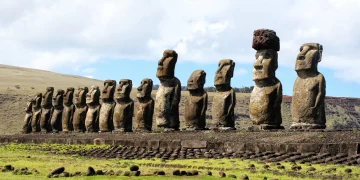










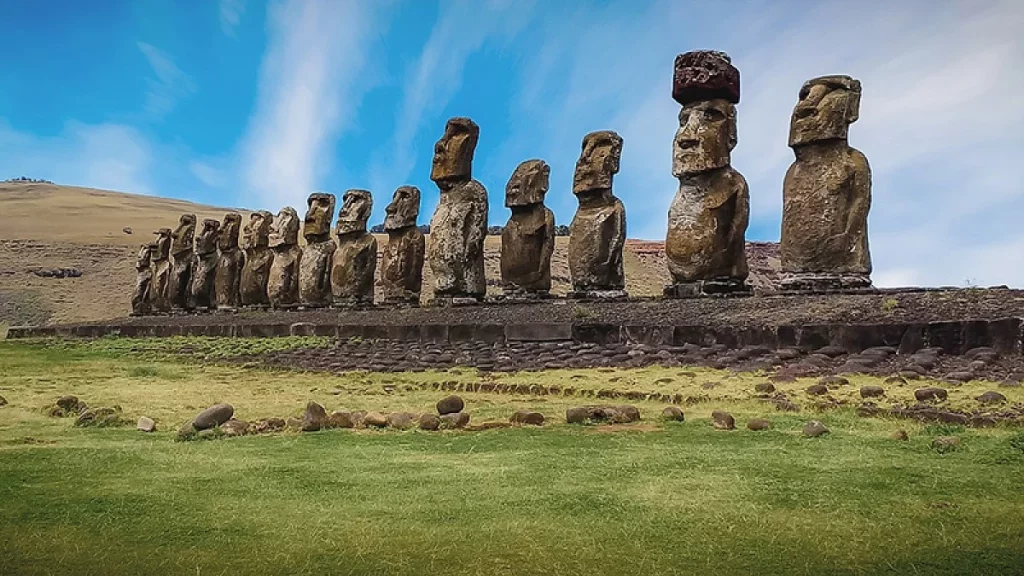
Easter Island, or Rapa Nui, located in the southeastern Pacific Ocean, is world-renowned for its enigmatic Moai statues—massive monolithic figures carved from volcanic tuff between 1250 and 1500 CE. These statues, often towering up to 10 meters in height and weighing several tons, were positioned on ceremonial platforms called ahu throughout the island. One of the most enduring mysteries of archaeology is not merely how the Rapa Nui carved these colossal figures but how they transported them from quarries to their final destinations, often several kilometers away.
This article examines the historical, cultural, and engineering aspects of Moai transport, drawing upon archaeological evidence, experimental reconstructions, ethnographic studies, and modern theoretical approaches. It also explores the implications of these findings for understanding Rapa Nui society, technology, and ingenuity.
1. Introduction to Moai Statues
1.1 Historical Context
- Carved primarily from volcanic tuff in the Rano Raraku quarry.
- Construction of Moai reflects the social, religious, and political complexity of the Rapa Nui society.
- Moai represent ancestral figures, emphasizing lineage and spiritual guardianship over clans.
1.2 Physical Characteristics
- Height ranges from 3 to 10 meters; some exceptional statues exceed 20 meters.
- Weight varies widely: smaller Moai around 4–5 tons, larger statues up to 82 tons.
- Distinctive features include oversized heads, elongated noses, heavy brows, and subtle torsos.
1.3 Distribution and Orientation
- Moai are predominantly located along coastal ahu, facing inland toward the villages they protect.
- Over 900 statues have been identified across the island, suggesting extensive planning and logistical coordination.
2. Traditional Theories on Moai Transport
2.1 Rolling on Logs Theory
- Proposed in the early 20th century: Moai were laid horizontally on wooden sleds and rolled on cylindrical logs.
- Advantages: feasible with available timber and manpower.
- Challenges: deforestation could have limited availability of suitable logs; terrain is uneven, with slopes and volcanic rock formations.
2.2 Sled and Track System
- Archaeologists suggested the use of wooden sleds or frames that slid over prepared tracks of logs or planks.
- Experiments demonstrated feasibility for smaller statues but raised questions about stability and manpower for larger Moai.
2.3 Human-Haul Hypothesis
- Polynesian oral traditions describe Moai as “walking” to their destinations.
- Researchers proposed coordinated rocking movements, with teams alternately pulling and pivoting the statues forward.
- This method explains upright transport and minimal damage to statues and terrain.
3. Recent Experimental Archaeology
3.1 “Walking” Moai Experiments
- In 2012–2013, archaeologists Terry Hunt and Carl Lipo conducted experiments using replicas of Moai.
- Method: ropes attached to the sides, teams alternately tilted and swayed statues in a forward motion.
- Results: small teams could move a 4-ton replica along a simulated path; the statue appeared to “walk” with minimal friction.
- Implications: suggests ancient Rapa Nui may have used this technique for upright transport, matching oral tradition accounts.
3.2 Sled-and-Rope Experiments
- Involving horizontal transport with wooden frames and lubrication with wet clay or leaves.
- Demonstrated effectiveness over short distances but posed challenges on steep slopes and rugged terrain.
3.3 Lessons from Modern Reconstructions
- Human coordination and communication were critical for safe movement.
- Terrain preparation, such as smoothing paths and constructing ramps, likely facilitated transport.
- Some statues may have required partial disassembly or staged transport for especially large Moai.
4. Archaeological Evidence Supporting Transport Theories
4.1 Quarry Marks and Roads
- Rano Raraku quarry shows signs of quarrying ramps, pathways, and unfinished statues, indicating pre-planned transport strategies.
- Ancient roads, including sacred avenues, suggest deliberate routes linking quarries to ahu platforms.
4.2 Tool Marks and Ropes
- Stone chisels (toki) and traces of rope fibers indicate tools used for carving and likely for lifting or securing statues.
- Ethnographic analogs from Polynesian societies demonstrate traditional rope and lever techniques capable of moving heavy objects.
4.3 Orientation and Placement Patterns
- Upright placement may have facilitated religious or ceremonial significance during transport, reflecting spiritual practices.
- Placement patterns correspond with village networks, suggesting logistical coordination.
5. Cultural and Spiritual Dimensions of Moai Transport
5.1 Ancestral Worship
- Moai were more than decorative monuments; they embodied the mana (spiritual power) of ancestors.
- Transport methods likely incorporated rituals, chants, and communal ceremonies to invoke protection and success.
5.2 Community Coordination
- Movement of Moai required collective effort, reinforcing social cohesion, hierarchy, and leadership structures.
- Ceremonial aspects may have enhanced morale and social identity, turning a logistical challenge into a cultural practice.
5.3 Symbolism of the “Walking” Moai
- Oral traditions describing statues walking may reflect the perceived agency of ancestors.
- The anthropomorphic motion embodies a cultural narrative linking the spiritual and material worlds.
6. Engineering Considerations
6.1 Weight Distribution and Center of Gravity
- Upright transport reduces friction but requires precise coordination to maintain balance.
- Rocking motion shifts the center of gravity forward, enabling progressive steps with minimal force.
6.2 Terrain Adaptation
- Coastal cliffs, volcanic slopes, and narrow paths demanded route planning and potentially temporary scaffolding.
- Some larger statues may have been partially hollowed at the back to reduce weight.
6.3 Rope Mechanics and Leverage
- Strong braided ropes made from local fibers could support tens of tons.
- Teams coordinated through rhythm and visual cues, using mechanical advantage with levers and fulcrums.
7. Debates and Alternative Theories
7.1 Pukao Transport (Topknots)
- Some Moai feature pukao—red scoria hats weighing several tons.
- Proposed methods: rolling on logs, sliding along ramps, or incremental lifting.
- Debate: whether pukao were transported separately or attached post-placement.
7.2 External Intervention Theories
- Fringe theories suggested alien assistance or lost technology.
- Archaeological evidence strongly supports indigenous innovation and expertise.
7.3 Environmental Implications
- Initial deforestation hypotheses suggested Moai transport contributed to ecological collapse.
- Recent studies indicate sustainable transport strategies were likely employed, minimizing environmental impact.
8. Integration of Archaeology, Ethnography, and Experimentation
- Combining physical experiments with ethnographic records and quarry surveys provides the most plausible explanations.
- Modern techniques, including 3D modeling and physics simulations, help reconstruct feasible transport paths and forces required.
- Multidisciplinary approaches reaffirm that Rapa Nui people possessed sophisticated engineering knowledge, social organization, and spiritual motivation.
9. Implications for Understanding Rapa Nui Society
9.1 Social Organization
- Moai transport required hierarchical coordination, demonstrating leadership, labor mobilization, and community participation.
9.2 Technological Ingenuity
- Ingenious solutions for friction reduction, leverage, and cooperative motion reflect adaptive engineering skills.
9.3 Cultural Identity
- The effort invested in moving and erecting Moai reinforced clan identity, ancestor veneration, and spiritual connection.
10. Preservation and Modern Engagement
10.1 Conservation Challenges
- Erosion, earthquakes, and tourism pose threats to standing Moai.
- Preservation strategies involve stabilization, documentation, and controlled visitor access.
10.2 Cultural Heritage and Education
- Archaeological parks and museums educate visitors about transport techniques, construction methods, and Rapa Nui culture.
- Community-led initiatives ensure local involvement in preservation and storytelling.
10.3 Scientific and Public Interest
- Experiments continue to engage both scholars and the public, bridging scientific research and experiential learning.
- Replication projects demonstrate practical feasibility while respecting cultural significance.
11. Conclusion
The transport of the Moai statues on Easter Island represents a remarkable convergence of human ingenuity, communal effort, and spiritual dedication. While the precise methods remain partially speculative, experimental archaeology, ethnographic studies, and archaeological evidence support the concept of statues “walking” upright with coordinated effort, supplemented by ramps, levers, and strategic use of materials.
Far from being merely monumental, the Moai exemplify the integration of engineering, culture, and ritual, illustrating the sophisticated capabilities of the Rapa Nui people. Their successful transport underscores the importance of social cohesion, leadership, and symbolic motivation in accomplishing seemingly impossible tasks.
Ultimately, the Moai remain both a technical marvel and a cultural beacon—testifying to the enduring legacy of Rapa Nui society and challenging modern observers to appreciate the depth of ancient Polynesian innovation. The mystery, beauty, and ingenuity of Moai transport continue to inspire researchers, travelers, and human imagination across the world.