









Introduction
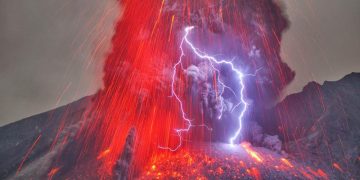
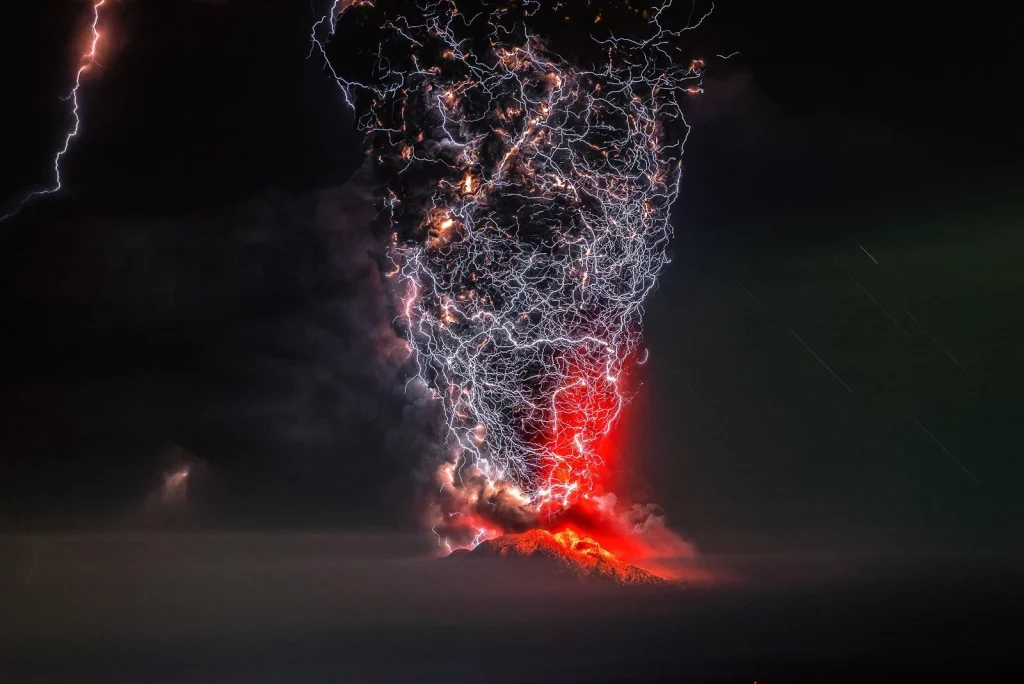
Volcanic thunderstorms—also known as volcanic lightning—are among the most spectacular and scientifically intriguing natural phenomena. Unlike conventional thunderstorms generated by atmospheric instability, volcanic lightning emerges directly from volcanic eruptions, intertwining geophysical processes, atmospheric physics, and electrostatic dynamics.
These storms occur in the ash plumes of explosive eruptions, where ash, gas, and pyroclastic material interact to generate massive electrical discharges. Observations have been reported in eruptions worldwide, from Mount Vesuvius in Italy to Mount Sakurajima in Japan and Eyjafjallajökull in Iceland. The study of volcanic lightning is crucial for volcanic hazard monitoring, understanding ash plume dynamics, and improving early warning systems.
This article provides a comprehensive examination of volcanic thunderstorm formation, detailing eruption physics, particle charging mechanisms, plume dynamics, environmental factors, observational methods, and recent advances in predictive modeling.
1. Historical Observations of Volcanic Lightning
1.1 Early Accounts
- Ancient chronicles described “flaming clouds” and “sky fires” during eruptions, hinting at lightning associated with volcanic activity.
- Historical eruptions like Mount Vesuvius (79 AD) and Krakatoa (1883) documented electrical discharges in ash clouds.
1.2 Modern Observational Advancements
- High-speed photography, satellite imagery, and lightning detection networks have confirmed the prevalence and intensity of volcanic lightning.
- Observations reveal that lightning often occurs near the vent and within the rising ash column, suggesting a direct link to eruption dynamics.
2. Physical Characteristics of Volcanic Thunderstorms
2.1 Lightning Types
- Vent Lightning: Occurs within tens to hundreds of meters from the eruptive vent, usually at the onset of eruption.
- Plume Lightning: Develops higher in the ash column, often kilometers above the volcano.
- Pyroclastic Flow Lightning: Associated with hot, fast-moving flows descending slopes, generating strong localized electric fields.
2.2 Electrical Parameters
- Volcanic lightning can reach peak currents exceeding 50 kA, comparable to intense thunderstorms.
- Lightning strikes often occur within seconds of explosive ejection, indicating rapid charge separation.
2.3 Spatial and Temporal Patterns
- Most frequent in Plinian eruptions, which produce high, buoyant plumes rich in fine ash.
- Occurs within the first minutes of eruption, though sustained plume activity can generate lightning for hours.
3. Mechanisms of Charge Generation
3.1 Particle Interaction and Triboelectrification
- Ash particles collide in turbulent plumes, transferring electrons through frictional contact (triboelectric charging).
- Smaller particles typically gain negative charges, while larger particles become positively charged, creating a vertical charge separation.
3.2 Fracture Charging (Fractoemission)
- Volcanic rocks and minerals fracture under explosive stress, releasing charged particles and ions into the plume.
- This contributes to localized electrical fields, particularly near the vent.
3.3 Ice and Hydrometeor Interaction
- In eruptions involving water (hydrovolcanism), supercooled water droplets can freeze, facilitating charge separation via mechanisms similar to conventional thunderstorms.
- This can amplify electrical potential, particularly in high-altitude ash clouds interacting with atmospheric moisture.
4. Dynamics of the Volcanic Plume
4.1 Plume Structure
- A typical plume consists of:
- Gas thrust region: Near the vent, dominated by high-velocity gas and coarse particles.
- Convective column: Rising plume driven by buoyancy, with fine ash and entrained air.
- Umbrella region: Horizontal spreading at neutral buoyancy, where particles can interact over large distances.
4.2 Turbulence and Mixing
- Turbulent flows enhance particle collisions, promoting charge separation.
- Convective updrafts and downdrafts create layered charge zones, analogous to thunderstorm stratification.
4.3 Particle Size and Composition
- Fine ash (less than 1 mm) remains suspended longer, increasing collision frequency and charge transfer efficiency.
- Mineral composition (silica, magnetite, and other ferromagnetic particles) influences triboelectric properties.
5. Electrical Field Development
5.1 Charge Separation
- Vertical stratification in the plume leads to upper positive charge and lower negative charge, creating strong electric fields.
- Lateral shearing and turbulence can induce horizontal charge heterogeneity, producing complex lightning pathways.
5.2 Breakdown of Air Insulation
- When the electric field exceeds air breakdown strength (~3 MV/m), dielectric breakdown occurs, producing visible lightning.
- High particle concentration lowers the breakdown threshold, facilitating frequent discharges in dense plumes.
5.3 Interaction with Atmospheric Electric Field
- Preexisting atmospheric electric fields (from weather systems) can enhance or suppress volcanic lightning.
- Ash plumes may trigger conventional cloud-to-ground lightning if they penetrate storm layers.
6. Environmental Factors Influencing Volcanic Lightning
6.1 Eruption Intensity
- Larger eruptions with higher eruption columns produce more intense and frequent lightning.
- Explosive magma (andesitic, dacitic, rhyolitic) generates highly fragmented ash, enhancing particle collisions.
6.2 Humidity and Atmospheric Moisture
- Moist air promotes ice formation and water droplet collisions, amplifying charge separation.
- Dry eruptions produce lightning primarily through triboelectrification, while humid eruptions combine ice and particle mechanisms.
6.3 Wind Shear and Plume Dispersion
- Strong winds can tilt plumes, stretching charge layers and influencing lightning strike locations.
- Lateral spreading in the umbrella region affects spatial distribution of discharges.
7. Observational Methods
7.1 Ground-Based Observations
- High-speed cameras capture rapid discharges and spatial distribution.
- Electromagnetic sensors measure field strength, peak current, and discharge frequency.
7.2 Aerial and Satellite Observations
- Satellite sensors (e.g., GOES, Meteosat) detect thermal anomalies and lightning flashes.
- Drones and aircraft provide close-range imaging and particle sampling.
7.3 Lightning Detection Networks
- Networks like WWLLN (World Wide Lightning Location Network) and VLF sensors track real-time volcanic lightning globally.
- Combined with volcanic monitoring, these systems improve eruption early warning and plume tracking.
8. Implications for Volcanic Hazard Management
8.1 Ash Plume Monitoring
- Volcanic lightning serves as a real-time indicator of explosive activity, often preceding seismic or ground-based observations.
- Aviation safety relies on timely detection, as lightning signals dense ash plumes capable of damaging aircraft.
8.2 Early Warning and Evacuation Planning
- Lightning frequency correlates with eruption intensity, providing immediate hazard assessment.
- Monitoring can inform emergency response decisions, particularly in populated areas.
8.3 Research and Predictive Modeling
- Incorporating electrostatic measurements into numerical eruption models enhances predictions of ash dispersal and plume dynamics.
9. Advances in Research and Modeling
9.1 Laboratory Simulations
- High-speed wind tunnels and volcanic ash simulators replicate particle collisions and charge accumulation.
- Experiments demonstrate triboelectric charging efficiency, particle size effects, and plume conductivity.
9.2 Computational Models
- Electrostatic plume models simulate charge distribution, electric field evolution, and lightning initiation.
- Coupled fluid dynamics and electrostatics models provide insights into plume height, turbulence, and lightning frequency.
9.3 Interdisciplinary Studies
- Integrating geophysics, atmospheric science, and electrical engineering enhances understanding.
- Studies link magmatic composition, eruption style, and plume meteorology to lightning activity.
10. Case Studies
10.1 Mount Sakurajima, Japan
- Frequent small eruptions produce continuous vent lightning, observable in near-real time.
- Lightning frequency correlates with ash ejection rate and column height.
10.2 Eyjafjallajökull, Iceland (2010)
- Explosive eruptions disrupted air traffic; ash plume produced intense lightning storms detected by satellite.
- Data confirmed triboelectrification in dry Icelandic ash as primary mechanism.
10.3 Mount Redoubt, Alaska (2009)
- Volcanic lightning detected kilometers above the vent, demonstrating high-altitude plume electrification.
- Lightning provided early warning of ash dispersal impacting aviation routes.
11. Future Directions and Challenges
11.1 Improving Early Warning Systems
- Real-time lightning monitoring combined with seismic and infrasound data can enhance eruption response.
11.2 Understanding Multi-Mechanism Interactions
- Future research aims to quantify relative contributions of triboelectrification, fractoemission, and ice processes under diverse eruption scenarios.
11.3 Climate Interaction
- Volcanic lightning contributes to local atmospheric chemistry, potentially affecting ozone, aerosols, and cloud formation.
- Understanding these interactions requires climate-sensitive plume modeling.
11.4 Technological Innovations
- Development of miniaturized sensors, drone-based monitoring, and AI-driven lightning prediction is revolutionizing volcanic meteorology.
Conclusion
Volcanic thunderstorms represent a unique interplay of geology, atmospheric physics, and electrostatics, providing both visual spectacle and critical scientific insight. Their formation is driven by complex charge separation mechanisms, turbulent plume dynamics, eruption intensity, and environmental conditions.
Studying volcanic lightning advances our understanding of eruption processes, plume behavior, and natural hazard management. With modern observation tools, laboratory simulations, and computational modeling, scientists are unraveling the electrodynamic intricacies of volcanic ash plumes, enhancing early warning systems and improving global hazard preparedness.
Volcanic lightning not only illuminates the skies but also illuminates the hidden physics of the Earth’s most explosive phenomena, bridging geophysics, atmospheric science, and human safety considerations.