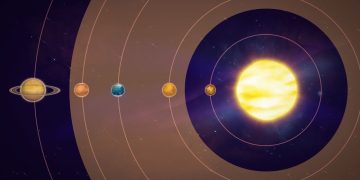










Europa, one of Jupiter’s largest moons, has captured the imagination of scientists and the public alike due to its potential to harbor extraterrestrial life. With a global subsurface ocean beneath an icy crust, Europa presents one of the most promising environments for life beyond Earth. Recent studies in planetary science, astrobiology, and oceanography have increasingly focused on understanding the moon’s composition, geophysical processes, and energy sources that might make it habitable.
This article provides a comprehensive overview of Europa’s characteristics, the evidence for its subsurface ocean, the factors that could support life, and the scientific missions aiming to uncover its secrets. It examines Europa from multiple scientific perspectives, integrating planetary science, chemistry, and astrobiology to offer a professional, in-depth understanding of this fascinating world.
1. Introduction: Europa and Its Place in the Solar System
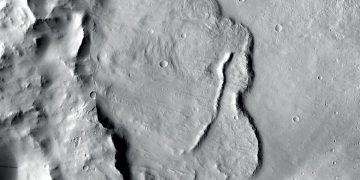
Europa is the fourth-largest moon of Jupiter, slightly smaller than Earth’s Moon, with a diameter of about 3,121 kilometers. It was discovered by Galileo Galilei in 1610, alongside Io, Ganymede, and Callisto. Europa stands out among the Galilean moons for its smooth, bright, icy surface, which is crisscrossed by linear fractures and ridges. These surface features hint at dynamic geological activity and potential interactions between the icy crust and an underlying liquid ocean.
Europa’s orbit around Jupiter is characterized by tidal interactions, which generate internal heat through friction. This heat may be sufficient to maintain a liquid ocean beneath the ice, despite the extremely cold temperatures on the surface, which average around -160°C (-260°F). Such an ocean, potentially containing more than twice the water of all Earth’s oceans combined, raises the tantalizing possibility that life could exist in environments completely isolated from sunlight.
2. Geological and Physical Characteristics
2.1 Surface Ice and Terrain
Europa’s surface is predominantly water ice, reflecting sunlight efficiently and giving the moon its bright, white appearance. Key geological features include:
- Linear fractures and ridges: These are long, straight cracks in the ice that suggest tectonic activity and resurfacing.
- Chaos terrain: Areas of broken ice blocks that appear to have shifted or rotated, possibly due to upwelling from liquid water below.
- Impact craters: Sparse compared to other moons, indicating a relatively young surface age of around 40–90 million years.
These features indicate that the ice shell is not static but dynamic, potentially exchanging material with the underlying ocean and creating habitats where life could survive.
2.2 Subsurface Ocean Evidence
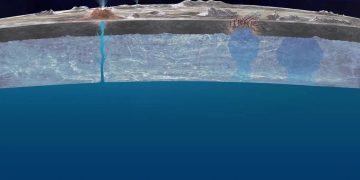
The most compelling evidence for a subsurface ocean includes:
- Induced magnetic field measurements: Data from the Galileo spacecraft suggest Europa has a conductive layer beneath its surface, consistent with a salty, liquid ocean.
- Surface chemistry: Spectroscopic observations reveal salts and hydrated compounds on the ice, indicating interactions with liquid water below.
- Tidal flexing: Gravitational interactions with Jupiter produce heat and stress in the ice, which could help maintain liquid water beneath the surface.
Current estimates suggest the ocean could be 50–150 kilometers deep, covered by an ice shell 10–30 kilometers thick.
3. Chemical Composition and Energy Sources
Life, as we understand it, requires liquid water, organic molecules, and energy sources. Europa exhibits several factors that may fulfill these requirements:
3.1 Water and Salts
The subsurface ocean is likely composed of water with dissolved salts, similar to Earth’s oceans. Sodium, magnesium, and sulfate ions detected on the surface support the hypothesis of a saline ocean. The presence of salts can lower the freezing point of water, allowing the ocean to remain liquid under the icy crust.
3.2 Organic Compounds
Spectroscopic studies have suggested the possible presence of simple organic molecules on Europa’s surface. These molecules may originate from:
- Cometary and meteoritic material impacting the surface.
- Endogenous processes within the ocean, such as hydrothermal activity at the seafloor.
3.3 Energy Sources
Energy is essential for sustaining life, and Europa may possess multiple sources:
- Tidal heating: Gravitational interaction with Jupiter creates friction, generating heat that maintains the subsurface ocean.
- Radiation-driven chemistry: High-energy particles from Jupiter’s magnetosphere interact with the ice, potentially creating oxidants like hydrogen peroxide.
- Hydrothermal vents: If Europa has a rocky mantle in contact with the ocean, hydrothermal vents could provide chemical energy, analogous to deep-sea vents on Earth.
These energy sources could create redox gradients, essential for chemical reactions that support microbial life.
4. Habitability Potential
Europa is considered one of the prime candidates for extraterrestrial life in the Solar System due to several factors:
- Global ocean: The ocean could support life on a large scale, with a volume estimated to be twice that of Earth’s oceans.
- Chemical nutrients: Salts, carbon compounds, and possibly oxidants may provide the building blocks for life.
- Stable environment: Beneath the ice, the ocean is insulated from extreme surface temperatures and radiation, providing a relatively stable habitat.
4.1 Possible Life Forms
Life on Europa, if it exists, would likely be microbial or simple multicellular organisms, similar to extremophiles on Earth:
- Chemoautotrophs: Organisms that derive energy from chemical reactions rather than sunlight, possibly near hydrothermal vents.
- Psychrophiles: Cold-tolerant microbes adapted to the icy environment.
- Suspended life in the water column: Microbial life could float in the subsurface ocean, potentially interacting with nutrients diffused from the ice or seafloor.
The thick ice crust may limit photosynthesis, suggesting life would rely on chemical energy rather than light.
5. Surface-Ocean Interaction
The potential for interaction between Europa’s ice shell and its ocean is critical for habitability:
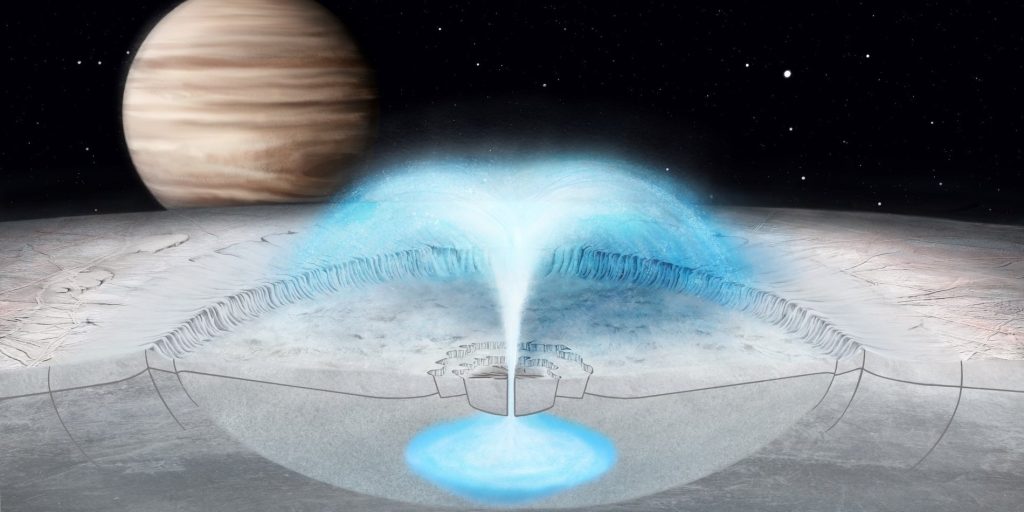
- Cryovolcanism: Ice from the ocean may occasionally erupt to the surface, transporting nutrients and organic compounds.
- Brine pockets: Pockets of concentrated saline water within the ice could serve as microhabitats for life.
- Plumes: Observations by the Hubble Space Telescope suggest water vapor plumes erupt from Europa, potentially ejecting material from the ocean to space, providing opportunities for remote sampling.
Such interactions are crucial for nutrient cycling and maintaining a chemically active environment.
6. Scientific Missions and Exploration
Several missions have been proposed or are underway to study Europa and assess its habitability:
6.1 Galileo Mission
- Timeframe: 1995–2003
- Achievements: Provided magnetic field data, ice spectroscopy, and surface imaging, establishing strong evidence for a subsurface ocean.
6.2 Hubble Space Telescope Observations
- Achievements: Detected potential water vapor plumes and surface composition features suggestive of ocean-surface interactions.
6.3 Europa Clipper (NASA)
- Launch: Planned for the mid-2020s
- Objectives: Conduct detailed reconnaissance of Europa’s ice shell, ocean, composition, and habitability potential using remote sensing instruments.
- Significance: Will map the ice thickness, analyze surface chemistry, and search for signs of activity or plumes.
6.4 JUICE (ESA – Jupiter Icy Moons Explorer)
- Launch: 2023, arrival in 2029
- Objectives: Focus on Ganymede, but will also study Europa, examining ice, potential subsurface ocean, and magnetospheric interactions.
7. Challenges to Habitability
Despite its promise, Europa faces several challenges to life:
- Extreme radiation: Jupiter’s magnetosphere bombards the surface with radiation, making the ice layer inhospitable. Life would need to reside beneath the ice.
- Limited nutrient supply: The isolation of the ocean under thick ice could restrict the availability of energy and essential elements.
- Low temperatures: The ocean is cold, likely near -20°C in salty regions, which constrains the metabolic rates of potential life.
Nonetheless, extremophiles on Earth demonstrate that life can thrive under conditions far beyond those found in typical terrestrial environments.
8. Implications for Astrobiology
Europa’s oceanic environment has broad implications for the search for life:
- Analog for icy exoplanets: Understanding Europa’s habitability informs studies of exoplanets and exomoons with subsurface oceans.
- Life without sunlight: Demonstrates that life can exist independent of photosynthesis, relying on chemical energy.
- Planetary protection: Future missions must carefully avoid contaminating Europa’s ocean with Earth microbes.
9. Conclusion: Europa as a Frontier of Life Discovery
Europa represents one of the most promising locations in the Solar System for discovering extraterrestrial life. Its global subsurface ocean, geophysical activity, and potential chemical energy sources create an environment where life, if it exists, could thrive. With upcoming missions like Europa Clipper and ESA’s JUICE, scientists will gain unprecedented insights into the moon’s ice shell, ocean, and habitability.
The study of Europa is not just a pursuit of knowledge about a distant moon—it reshapes our understanding of where life can exist and challenges assumptions about the exclusivity of Earth-like conditions. As we probe its icy surface and hidden ocean, Europa stands as a compelling reminder that life may flourish in places beyond our imagination, beneath the icy crusts of distant worlds.