









Göbekli Tepe, perched atop a hill in southeastern Turkey, has dramatically altered our understanding of the origins of human civilization. Dating back to the 10th millennium BCE, this monumental site predates Stonehenge by over six thousand years and challenges long-held assumptions about the development of organized society, religion, and monumental architecture. Its discovery has sparked intense scholarly debate, forcing archaeologists, historians, and anthropologists to reconsider when and how humans transitioned from hunter-gatherer communities to structured societies capable of complex construction and ritual activity.
This article provides an in-depth examination of Göbekli Tepe’s archaeology, its architectural and symbolic features, its impact on the understanding of Neolithic civilization, and the broader implications for the origins of organized religion and social complexity.
1. Introduction: A Revolutionary Discovery
Discovered in the 1960s but only fully excavated beginning in the 1990s by Klaus Schmidt, Göbekli Tepe has challenged previous models of civilization development. Traditional narratives suggested that sedentary farming communities were necessary precursors to monumental construction and organized religion. Göbekli Tepe, however, appears to have been constructed by mobile hunter-gatherers long before evidence of domesticated crops in the region.
Key revolutionary implications include:
- Monumental construction predating agriculture.
- Evidence of sophisticated social organization in pre-farming societies.
- Religious and ritual activity as a driving force in early human social development.
2. Location, Geography, and Archaeological Context
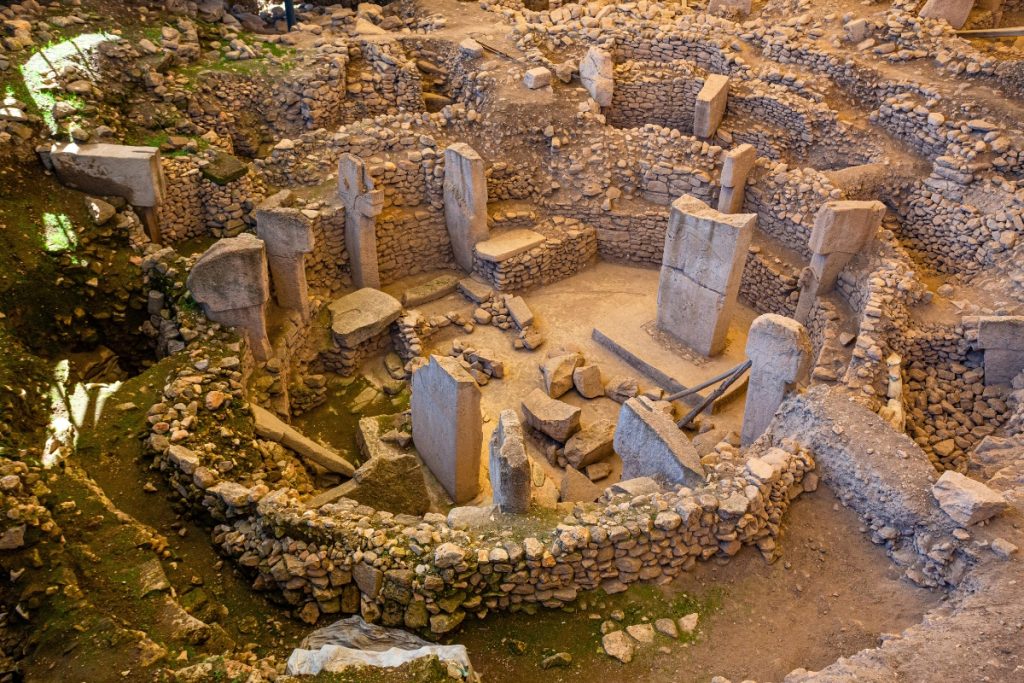
Göbekli Tepe is located in the Southeastern Anatolia Region of modern Turkey, approximately 15 kilometers northeast of Şanlıurfa. Its elevated hilltop position suggests a strategic selection, providing visibility over surrounding plains and symbolic prominence. The site consists of multiple circular and oval stone enclosures constructed using massive T-shaped limestone pillars, some of which weigh up to 20 tons.
2.1 Geological Significance
The region’s soft limestone allowed precise carving, enabling intricate reliefs of animals, abstract symbols, and human-like figures. Local availability of stone reduced the need for long-distance transport, yet the construction still required coordinated labor and advanced logistical planning.
2.2 Stratigraphy and Dating
Radiocarbon dating places the main construction phases between 9600 BCE and 8200 BCE. Earlier layers suggest the hill may have been inhabited for centuries prior, and its gradual accumulation of monumental enclosures indicates sustained, organized activity over generations.
3. Architectural Features
Göbekli Tepe’s architecture is unparalleled for its period. Key features include:
3.1 T-Shaped Pillars
The site’s most striking elements are the monumental T-shaped pillars arranged in circular and oval formations. These pillars, some reaching 5.5 meters in height, are arranged with two central pillars surrounded by smaller peripheral stones.
- Symbolism: Many scholars interpret the T-shape as anthropomorphic, representing stylized human figures, possibly ancestors or deities.
- Carvings: Pillars are adorned with reliefs of animals such as snakes, foxes, boars, and birds, alongside abstract symbols. The precise meaning remains debated, but they suggest complex symbolic and ritual thought.
3.2 Circular Enclosures
The enclosures range in diameter from 10 to 30 meters. Their repeated circular layout indicates a shared architectural blueprint and social coordination. Some enclosures are buried deliberately, possibly to signify the conclusion of a ritual or to sanctify the site.
3.3 Carving Techniques and Labor Organization
The carving and erection of such massive pillars required skilled labor, sophisticated knowledge of stone properties, and social coordination. This level of organization among pre-agricultural communities was previously considered impossible.
4. Symbolism and Religious Significance
Göbekli Tepe is widely interpreted as a ritual center. Its lack of domestic structures and absence of evidence for sustained habitation suggest its purpose was primarily ceremonial rather than residential.
4.1 Animal Iconography
Animal carvings dominate the reliefs, possibly representing cosmological beliefs, spiritual intermediaries, or symbolic narratives. Predators and prey depicted together may indicate early myths or ritual practices relating to hunting, survival, and social cohesion.
4.2 Abstract Symbols and Potential Proto-Writing
Some researchers suggest the repeated motifs and symbols may represent an early form of symbolic communication. While not a written language, these symbols may convey shared beliefs or collective knowledge critical to social cohesion.
4.3 Implications for Religion
Göbekli Tepe demonstrates that organized religious practices may have preceded agricultural development. Ritual construction may have driven early social collaboration, resource management, and territorial planning—challenging the conventional “farming first, religion second” model.
5. Impact on the Timeline of Civilization
The discovery of Göbekli Tepe has forced historians to reconsider several aspects of early civilization:
5.1 Pre-Agricultural Social Complexity
Previously, it was assumed that large-scale social organization arose only after farming enabled surplus production. Göbekli Tepe proves hunter-gatherers could mobilize labor for monumental projects, indicating complex social structures existed long before agriculture.
5.2 Religious Motivation in Social Evolution
The site supports theories that religious or ritual needs were primary catalysts for social complexity. The communal construction of ritual centers may have encouraged cooperation, hierarchy, and cultural identity formation, eventually leading to permanent settlements and agricultural development.
5.3 Technological Innovation
The transportation and erection of multi-ton pillars suggest advanced knowledge of leverage, coordination, and logistics, indicating technological ingenuity in a pre-farming society.
6. Comparative Analysis with Contemporary Sites
Göbekli Tepe’s scale and sophistication surpass other known sites from its era, such as:
- Nevali Çori: Located nearby, predating some later Neolithic villages, featuring smaller-scale ritual structures.
- Çatalhöyük: A later agricultural settlement with domestic dwellings and less emphasis on monumental ritual construction.
- Stonehenge and Megalithic Europe: These European sites postdate Göbekli Tepe by several millennia, illustrating the advanced nature of early Anatolian construction.
This comparison highlights the revolutionary nature of Göbekli Tepe and its role in rewriting the narrative of prehistoric social and religious development.
7. Excavation Challenges and Preservation
Excavating Göbekli Tepe presents unique challenges:
- Fragility of Limestone: Weathering threatens the carvings, requiring careful stabilization and conservation.
- Complex Stratigraphy: Multiple layers of construction and burial require meticulous documentation.
- Cultural Sensitivity: Maintaining the integrity of a sacred ancient site demands collaboration between archaeologists, local authorities, and heritage organizations.
Preservation strategies include controlled excavation, protective shelters, and digital documentation for research and education.
8. Theories and Scholarly Debates
Göbekli Tepe has generated several interpretive debates:
- Purpose: Was it a sanctuary, a center for ancestor worship, or an astronomical observatory?
- Social Organization: How did non-agricultural hunter-gatherers coordinate labor at such a scale?
- Agricultural Development: Did the construction of ritual centers like Göbekli Tepe motivate the shift to farming?
While no consensus exists, the debates underscore the site’s significance in rethinking human prehistory.
9. Broader Implications for Human History
Göbekli Tepe challenges traditional linear models of civilization:
- Civilization did not emerge solely from agricultural surplus.
- Ritual and religious motivation may have been central to early social complexity.
- Monumental architecture predates sedentary settlements by millennia, redefining the origin of complex society.
These insights reshape the understanding of human cultural evolution, emphasizing the role of belief, symbolism, and collaboration in shaping our ancestors’ societies.
10. Future Research Directions
Ongoing studies aim to further illuminate Göbekli Tepe’s mysteries:
- Subterranean Structures: Excavating deeper layers may reveal additional enclosures or chronological information.
- Symbolic Interpretation: Detailed analysis of carvings could clarify spiritual and cosmological significance.
- Regional Connections: Comparative studies with other Neolithic sites may illuminate trade, cultural exchange, and migration patterns.
- Technological Analysis: Investigating quarrying, carving techniques, and transportation methods provides insight into prehistoric engineering skills.
11. Conclusion
Göbekli Tepe is more than an archaeological marvel; it is a transformative discovery that challenges conventional assumptions about the origins of civilization. By demonstrating that hunter-gatherer societies were capable of monumental architecture, complex social organization, and sophisticated symbolic thought, Göbekli Tepe reshapes the timeline of human development.
Its existence underscores the significance of religious and ritual practices as catalysts for social evolution, suggesting that the drive for communal spiritual expression may have preceded agriculture and permanent settlements. As excavation and research continue, Göbekli Tepe promises to offer deeper insights into the dawn of civilization, redefining humanity’s understanding of its own origins.