









Introduction
Among the many dramatic displays of electrical activity in Earth’s atmosphere, lightning stands as one of the most awe-inspiring phenomena. However, there exists a lesser-known and equally fascinating form of lightning that occurs far above the storm clouds—an ethereal, fleeting burst of light that has puzzled scientists for decades. This phenomenon is known as red sprites, a type of upper-atmospheric lightning. Despite their striking appearance, red sprites have only been widely recognized and studied since the late 20th century.
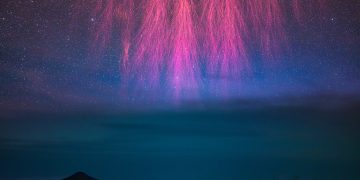
Red sprites are large-scale electrical discharges that occur high above thunderstorms, in the mesosphere and lower ionosphere, at altitudes ranging from 30 to 90 kilometers (about 19 to 56 miles) above the Earth’s surface. These lightning-like flashes are typically red in color and are often described as looking like a “jellyfish” or a “tree” due to their branching structure. The phenomenon is not only visually stunning but also scientifically significant, as it provides insights into the complex electrical processes that occur in Earth’s atmosphere.
In this article, we will explore the nature of red sprites, how they form, their connection to traditional lightning, and their role in atmospheric science. We will also delve into their discovery, their impact on our understanding of electrical phenomena, and the future of sprite research.
What Are Red Sprites?
Red sprites are a type of transient luminous event (TLE) that occurs in the upper regions of Earth’s atmosphere, typically above thunderstorms. Unlike conventional lightning, which is a discharge between clouds or between the ground and clouds, red sprites are high-altitude discharges that occur above thunderstorm clouds.
These phenomena were first documented by scientists in the 1980s, although they had likely been occurring unnoticed for centuries. Red sprites are triggered by the powerful electrical activity of thunderstorms, but they manifest in a completely different part of the atmospheric structure. The name “sprite” comes from their ghostly, fleeting nature and the red color they emit, which is due to the specific wavelengths of light generated during their formation.
Characteristics of Red Sprites
- Color and Appearance: Red sprites are typically red or reddish-orange in color, a result of the ionization of nitrogen molecules in the upper atmosphere. The light they emit is in the red to near-infrared part of the spectrum. The sprites often take on the shape of a cluster of filaments or tendrils, which can resemble jellyfish, trees, or columns. These shapes are due to the complex electrical discharge patterns in the ionosphere.
- Size and Duration: Sprites can span large areas, often several tens of kilometers wide and up to 90 kilometers in altitude. Despite their size, they are remarkably brief, lasting only a few milliseconds. Their transient nature makes them difficult to observe and study, requiring specialized equipment to capture their fleeting flashes.
- Altitude and Location: Red sprites occur high in the atmosphere, typically at altitudes between 30 and 90 kilometers (about 19 to 56 miles). They form well above the thunderstorm clouds, in the region known as the mesosphere and lower ionosphere. This is in stark contrast to regular lightning, which occurs within or between storm clouds, or from clouds to the ground.
How Do Red Sprites Form?
Red sprites are part of a family of phenomena known as transient luminous events (TLEs), which also includes blue jets, elves, and trolls. All of these events are electrical discharges that occur at high altitudes above thunderstorms. The formation of red sprites is closely tied to the dynamics of thunderstorm activity and the electrical fields generated within these storms.
1. Thunderstorm Activity and Lightning Strikes
The formation of red sprites is directly linked to the occurrence of intense lightning strikes within thunderstorm clouds. When a large thunderstorm generates a powerful cloud-to-ground lightning strike, it creates a positive lightning flash—a type of lightning that carries a positive charge rather than the more typical negative charge.
These positive lightning strikes are far more energetic than typical negative strikes and can produce an intense electric field in the upper atmosphere. When this electric field becomes sufficiently strong, it ionizes the air in the mesosphere and lower ionosphere, initiating a discharge that produces the red sprite.
2. Electrical Discharge and Ionization
Red sprites occur when the electric field caused by a positive lightning strike is strong enough to ionize the gases in the upper atmosphere. This ionization process occurs primarily in nitrogen molecules, which emit red light when excited by the energy of the discharge. As the ionized air returns to its neutral state, it releases photons, producing the characteristic red glow associated with red sprites.
3. Electric Field Disturbance
The intense lightning strike does more than just create a simple spark. It generates a vast, high-voltage electric field that extends well into the ionosphere, a region of the atmosphere that is ionized by solar radiation. When the electric field becomes sufficiently strong, it disrupts the equilibrium of electrons and ions in the ionosphere, leading to a cascading effect of ionization that results in the luminous display known as a red sprite.
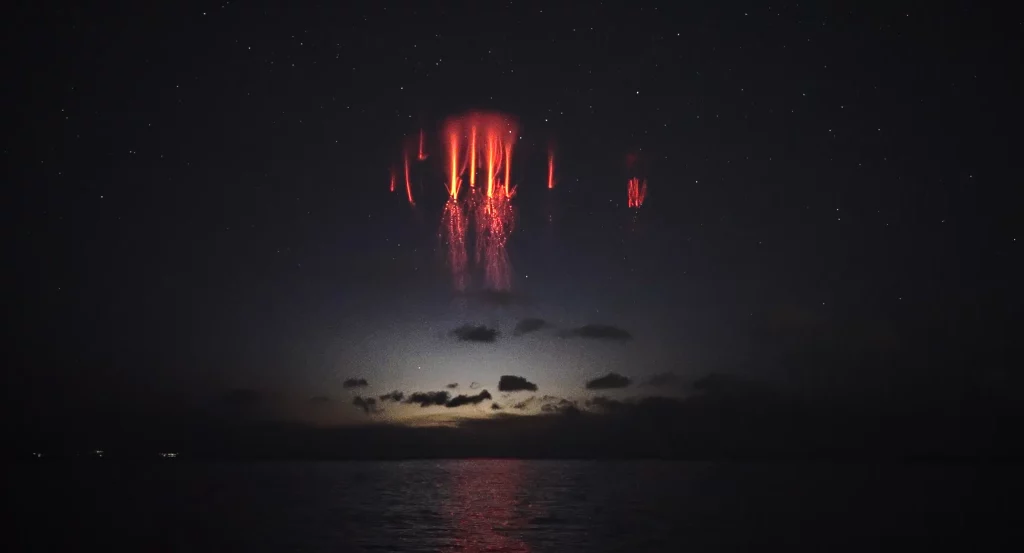
Red Sprites and Other Transient Luminous Events
Red sprites are part of a broader family of transient luminous events (TLEs) that occur in the upper atmosphere above thunderstorms. Other TLEs, such as blue jets, elves, and trolls, are also fascinating electrical phenomena that have distinct characteristics but are closely related to sprites in terms of their formation processes.
1. Blue Jets
Blue jets are another type of TLE that occur at high altitudes above thunderstorms, but unlike red sprites, blue jets are blue in color and have a different shape. Blue jets are cone-shaped electrical discharges that occur above the thunderstorm top, typically at altitudes between 10 and 50 kilometers. Blue jets are much more localized than sprites and are typically seen as a sudden burst of blue light extending upward from the storm cloud.
2. Elves
Elves are a type of TLE that occur above thunderstorms in the ionosphere. Unlike red sprites, which are highly visible and extend downward toward the Earth, elves are wide, rapidly expanding rings of light that occur in the upper atmosphere. They are typically observed as brief flashes of light in the upper mesosphere and are caused by the ionization of the atmosphere due to a lightning strike.
3. Trolls
Trolls are a more recently discovered TLE, and they occur at altitudes of around 30 kilometers. Unlike red sprites, trolls are much smaller and less well-understood. Their formation is believed to be linked to strong electrical fields created by lightning strikes that affect the behavior of electrons in the lower ionosphere.
The Discovery of Red Sprites
Although red sprites are thought to have been occurring for millennia, they were only scientifically documented in the late 20th century. Prior to the 1980s, the phenomenon had been reported by pilots and astronauts, who described unusual flashes of light above thunderstorms. However, these reports were often dismissed or misinterpreted due to the rarity and elusive nature of the event.
In 1989, scientists at the University of Minnesota, led by Dr. John R. Winckler, were the first to capture red sprites on video using high-speed cameras. Their observations confirmed the existence of these high-altitude lightning-like discharges, and further studies revealed that sprites were a common but largely invisible feature of thunderstorms.
The discovery of red sprites opened up a new area of atmospheric science, as scientists had previously believed that lightning was primarily a low-altitude phenomenon. Since the discovery, researchers have been able to use specialized instruments, such as high-speed cameras, electromagnetic field detectors, and satellite observations, to study red sprites and other TLEs in more detail.
The Role of Red Sprites in Atmospheric Science
Red sprites have become an important subject of study for atmospheric scientists, as they offer valuable insights into the dynamics of thunderstorms and the behavior of electrical fields in the upper atmosphere.
1. Understanding Thunderstorm Dynamics
Red sprites are indicative of the high-energy processes taking place within thunderstorms. By studying these phenomena, scientists can gain a better understanding of how energy is transferred in the atmosphere and how lightning strikes influence the ionization of the upper atmosphere. Red sprites are one of the few visible markers of the complex interactions between thunderstorm clouds and the ionosphere.
2. Global Electrical Circuit and Lightning Research
The study of red sprites also contributes to our understanding of Earth’s global electrical circuit. This circuit involves the flow of electrical charge from the Earth’s surface to the ionosphere and back, with lightning playing a key role in maintaining this balance. Red sprites provide a window into the upper reaches of this circuit, where large-scale electrical discharges occur at altitudes that are otherwise difficult to study.
3. Impact on Communication and Navigation
While red sprites themselves do not pose a direct threat to human life or infrastructure, their presence can have an impact on high-altitude aviation and satellite communications. The ionization caused by these high-energy discharges can affect radio signals and other electromagnetic systems. Understanding how red sprites interact with the ionosphere is therefore crucial for improving communication systems and ensuring the safety of high-altitude aircraft.
Conclusion
Red sprites are one of the most fascinating and mysterious phenomena in the Earth’s atmosphere. Their brief, ethereal flashes of red light offer a glimpse into the high-altitude electrical processes that occur far above the thunderstorm clouds. Despite their elusive nature, red sprites have opened up new areas of research in atmospheric science, providing valuable insights into the dynamics of thunderstorms, lightning, and the Earth’s global electrical circuit.
As scientists continue to study red sprites and other transient luminous events, we can expect to uncover more about the fundamental processes that govern our planet’s atmosphere. These fleeting flashes of light are not only a spectacular natural wonder but also a key to unlocking the deeper mysteries of the skies.